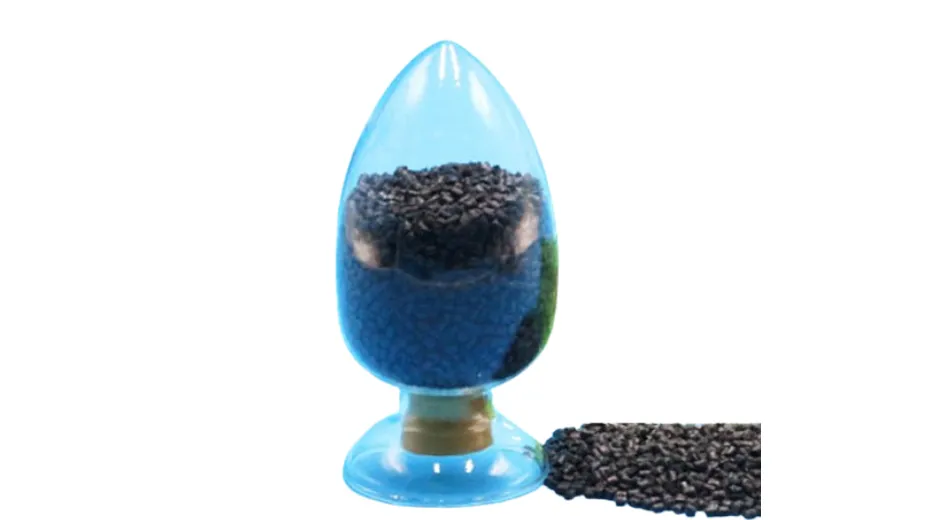
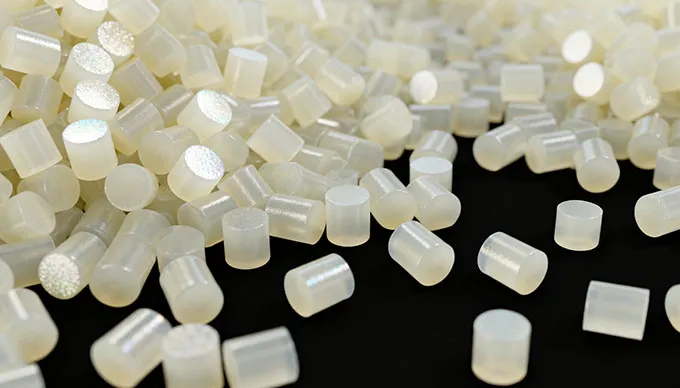
Features of 330GL30 Glass Fiber Reinforced(GF) PEEK
Reinforcement Type: 30% glass fiber (GF) by mass, which is uniformly dispersed in the PEEK matrix to improve rigidity and reduce creep.
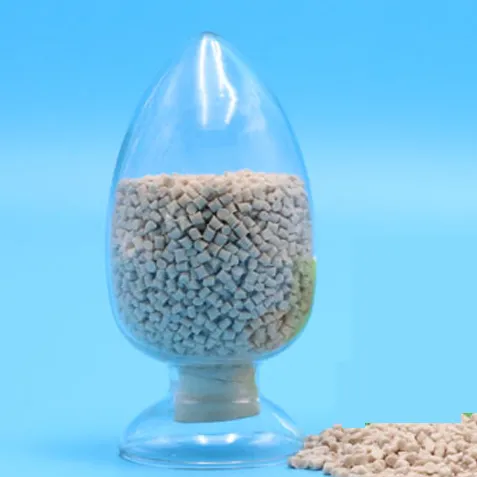
Form & Processing: Available as natural/beige-colored pellets, optimized for injection molding. The material exhibits low viscosity and high fluidity, enabling precise filling of complex molds.
Thermal Stability: Retains PEEK’s inherent high-temperature performance with a glass transition temperature (Tg) of 143°C, melting point (Tm) of 340°C, and heat deflection temperature (HDT) of up to 315°C. It withstands continuous use at 260°C without significant loss of mechanical properties.
Mechanical Performance: The 30% GF reinforcement boosts tensile strength, stiffness, and impact resistance compared to pure PEEK. It maintains dimensional stability under load, resisting warping or deformation during use.
Other Properties: Exhibits excellent chemical resistance (compatible with oils, fuels, and corrosive chemicals), flame retardancy (UL94 V-0 rated), and electrical insulation—making it suitable for harsh environments.
Specifications of 330GL30 Glass Fiber Reinforced(GF) PEEK
 PEEK®—330GL30 PEEK®—330GL30 |
| Test Item | Test Standard | Test Conditions | Unit | Test Data |
| Mechanical Properties |
| Tensile Strength | ISO 527 | Fracture, 23°C | MPa | 185 |
| Elongation at Break | ISO 527 | Fracture, 23°C | % | 2.5 |
| Flexural Strength | ISO 178 | Fracture, 23°C | MPa | 275 |
| Flexural Modulus | ISO 178 | 23°C | GPa | 11.5 |
| Compressive Strength | ISO 604 | 23°C | MPa | 250 |
| Impact Strength of Simply Supported Beam | ISO 179/1eA | Notched | kJ m-2 | 7.5 |
| ISO 179/1U | Unnotched | kJ m-2 | 50 |
| Impact Strength of Cantilever Beam | ISO 180/A | Notched | kJ m-2 | 9 |
| ISO 180/U | Unnotched | kJ m-2 | 50 |
| Forming Shrinkage Rate | ISO 294-4 | Parallel to flow direction | % | 0.3 |
| Perpendicular to flow direction | % | 0.8 |
| Thermal Performance |
| Melting point | ISO 11357 | - | ℃ | 343 |
| Glass transition temperature | ISO 11357 | Initial | ℃ | 143 |
| Specific heat capacity | DSC | 23°C | kJ kg-1 ℃-1 | 1.7 |
| Thermal expansion coefficient | ISO 11359 | Below Tg along flow direction | ppm K-1 | 20 |
| Above Tg along flow direction | ppm K-1 | 20 |
| Heat deflection temperature | ISO 75-f | 1.8 Mpa | ℃ | 335 |
| Thermal conductivity | ISO 22007-4 | 23℃ | W m-1 K-1 | 0.3 |
| Liquidity |
| Melt Index | ISO 1133 | 380℃, 5kg | g 10min-1 | 28 |
| Others |
| Density | ISO 1183 | Crystalline | g cm-3 | 1.52 |
| Non-crystalline | g cm-3 | - |
| Shore D Hardness | ISO 868 | 23°C |
| 87 |
Water Absorption Rate (3.2mm Thick Tensile Rod)
(Immersion Test) | ISO 62-1 | 24 hours, 23°C | % | 0.04 |
| Equilibrium, 23°C | % | 0.3 |
| Electrical Properties |
| Dielectric Strength | IEC 60243-1 | 2mm | kV mm-1 | 23 |
| Compared to Tracking Index | IEC 60112 | - | V | 150 |
| Dielectric Constant | IEC 60250 | 23℃, 1kHz | - | 3.3 |
| 23℃, 50Hz | - | - |
| Tangent of Loss | IEC 60250 | 23℃, 1MHz | - | 0.004 |
| Volume Resistivity | IEC 60093 | 23℃, 1V | Ω cm | 1016 |
| 275℃ | Ω cm | - |
Applications of 330GL30 Glass Fiber Reinforced(GF) PEEK
330GL30 is widely used in industries requiring high-performance materials:
Automotive: Engine components, electrical connectors, and pump parts that demand thermal stability and mechanical strength.
Aerospace: Structural parts and components exposed to extreme temperatures and loads.
Oil & Gas: Equipment resistant to corrosion and high pressures.
Medical: Devices requiring biocompatibility and sterilization resistance (though additional validation may be needed for specific medical uses).
Electronics: Insulation for connectors and other components due to its electrical properties.
Processing & Handling Guidelines of 330GL30 Glass Fiber Reinforced(GF) PEEK
To optimize performance, follow manufacturer recommendations for injection molding:
Drying: Pre-dry pellets at 150–180°C for 2–4 hours to remove moisture and prevent hydrolysis.
Molding Temperature: Maintain a barrel temperature of 360–390°C and mold temperature of 150–180°C.
Injection Speed: Use medium to high injection speed to avoid defects and ensure uniform filling.
Always refer to the technical datasheet from the supplier (e.g., PEEK, Victrex) for detailed parameters tailored to your application.
 English