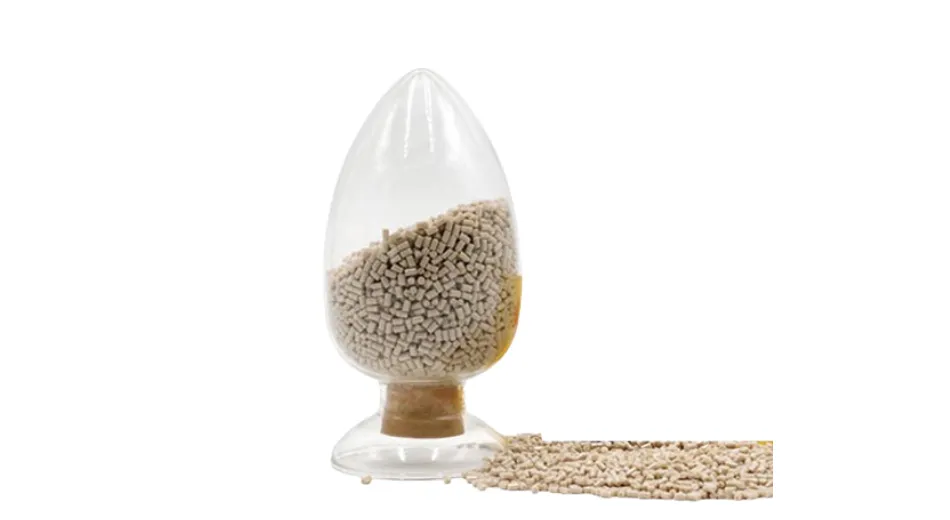
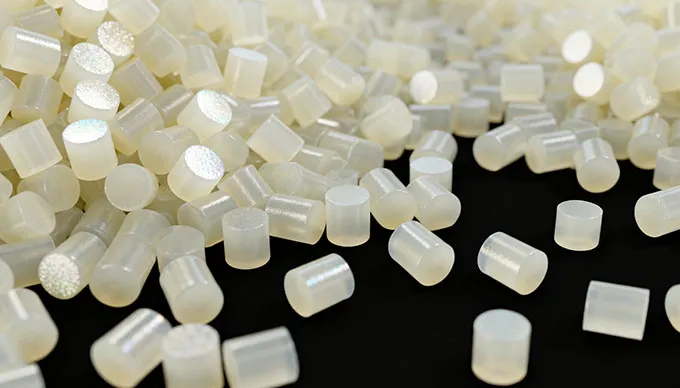
Features of 770GL30H Glass Fiber Reinforced(GF) PEEK
Tensile Strength: ~165-170 MPa (vs. ~90-100 MPa for pure PEEK), ensuring structural integrity under high loads.
Flexural Modulus: ~11,000 MPa, providing stiffness for precision components.
Impact Resistance: Balanced performance with Charpy notched impact strength (~9 kJ/m²) and unnotched impact strength (~50-55 kJ/m²), resisting fracture in dynamic environments.
Superior Thermal Stability 770GL30H retains PEEK’s exceptional heat resistance with:
Glass Transition Temperature (Tg): 143℃ (consistent with pure PEEK), indicating its semi-crystalline structure.
Heat Deflection Temperature (HDT): Up to 315-328℃ (at 1.8 MPa), enabling use in high-temperature applications (e.g., engine compartments).
Long-Term Use Temperature: 260℃ (UL 946B), maintaining mechanical properties over extended periods in harsh conditions.
Dimensional Stability The low linear thermal expansion coefficient of 770GL30H (comparable to metal aluminum) reduces warping and deformation during processing or operation. This makes it ideal for precision parts like semiconductor wafer carriers or medical implants, where tight tolerances are critical.
Chemical and Environmental Resistance 770GL30H inherits PEEK’s resistance to most chemicals (except concentrated sulfuric acid) and exhibits low water absorption (~0.04-0.3% after 24 hours). It also retains flame retardancy without additional additives, meeting UL94 V-0 standards (1.5mm thickness) and producing minimal smoke—key for aerospace and electronics safety. 5. Processing Characteristics As an injection-grade material, 770GL30H is designed for ease of molding:
Melt Flow Rate (MFR): 5 g/10min (at 380℃, 5.0kg), balancing flowability for complex geometries with structural integrity.
Shrinkage Rate: Low and controlled (MD: 0.8%, TD: 0.3%), minimizing dimensional deviations in molded parts.
Specifications of 770GL30H Glass Fiber Reinforced(GF) PEEK
 PEEK®—770GL30H PEEK®—770GL30H |
| Test Item | Test Standard | Test Conditions | Unit | Test Data |
| Mechanical Properties |
| Tensile Strength | ISO 527 | Fracture, 23°C | MPa | 165 |
| Elongation at Break | ISO 527 | Fracture, 23°C | % | 2.5 |
| Flexural Strength | ISO 178 | Fracture, 23°C | MPa | 255 |
| Flexural Modulus | ISO 178 | 23°C | GPa | 11 |
| Compressive Strength | ISO 604 | 23°C | MPa | 250 |
| Impact Strength of Simply Supported Beam | ISO 179/1eA | Notched | kJ m-2 | 8 |
| ISO 179/1U | Unnotched | kJ m-2 | 55 |
| Impact Strength of Cantilever Beam | ISO 180/A | Notched | kJ m-2 | 9 |
| ISO 180/U | Unnotched | kJ m-2 | 50 |
| Forming Shrinkage Rate | ISO 294-4 | Parallel to flow direction | % | 0.3 |
| Perpendicular to flow direction | % | 0.8 |
| Thermal Performance |
| Melting point | ISO 11357 | - | ℃ | 343 |
| Glass transition temperature | ISO 11357 | Initial | ℃ | 143 |
| Specific heat capacity | DSC | 23°C | kJ kg-1 ℃-1 | 1.7 |
| Thermal expansion coefficient | ISO 11359 | Below Tg along flow direction | ppm K-1 | 18 |
| Above Tg along flow direction | ppm K-1 | 18 |
| Heat deflection temperature | ISO 75-f | 1.8 Mpa | ℃ | 328 |
| Thermal conductivity | ISO 22007-4 | 23℃ | W m-1 K-1 | 0.3 |
| Liquidity |
| Melt Index | ISO 1133 | 380℃, 5kg | g 10min-1 | 5 |
| Others |
| Density | ISO 1183 | Crystalline | g cm-3 | 1.51 |
| Non-crystalline | g cm-3 | - |
| Shore D Hardness | ISO 868 | 23°C |
| 88 |
Water Absorption Rate (3.2mm Thick Tensile Rod)
(Immersion Test) | ISO 62-1 | 24 hours, 23°C | % | 0.04 |
| Equilibrium, 23°C | % | 0.3 |
| Electrical Properties |
| Dielectric Strength | IEC 60243-1 | 2mm | kV mm-1 | 21.5 |
| Compared to Tracking Index | IEC 60112 | - | V | 150 |
| Dielectric Constant | IEC 60250 | 23℃, 1kHz | - | 3.3 |
| 23℃, 50Hz | - | - |
| Tangent of Loss | IEC 60250 | 23℃, 1MHz | - | 0.005 |
| Volume Resistivity | IEC 60093 | 23℃, 1V | Ω cm | 5 1015 |
| 275℃ | Ω cm | - |
Applications of 770GL30H Glass Fiber Reinforced(GF) PEEK
Typical Applications 770GL30H’s performance profile suits it for high-demand sectors:
Aerospace: Lightweight structural components (e.g., aircraft fittings) that reduce weight and improve fuel efficiency.
Automotive: High-temperature parts like turbocharger housings, transmission components, and engine mounts, where heat and mechanical stress are prevalent.
Electronics: Insulation materials for wires/cables and connectors, leveraging its flame retardancy and thermal stability.
Medical: Implantable devices (e.g., dental crowns, orthopedic implants) due to its biocompatibility and resistance to body fluids.
Industrial: Seals, bearings, and pumps in chemical processing, where corrosion and wear resistance are critical. Supplier Information 770GL30H is commercially available from specialized PEEK manufacturers, including:
PEEK: Offers the GL Series (770GL30/770GL30H) with customization options for specific application requirements.
A Chinese producer supplying 770GL30H in bulk (1-ton minimum order) with competitive pricing (e.g., ¥58,000/ton for orders ≥1 ton).
 English