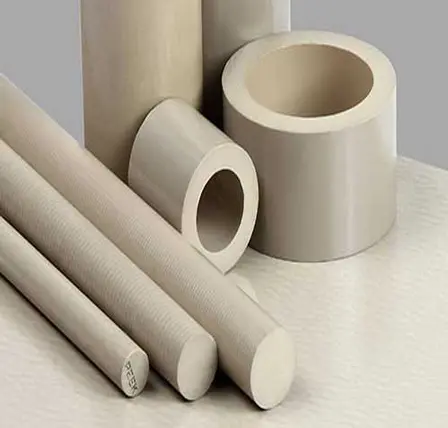
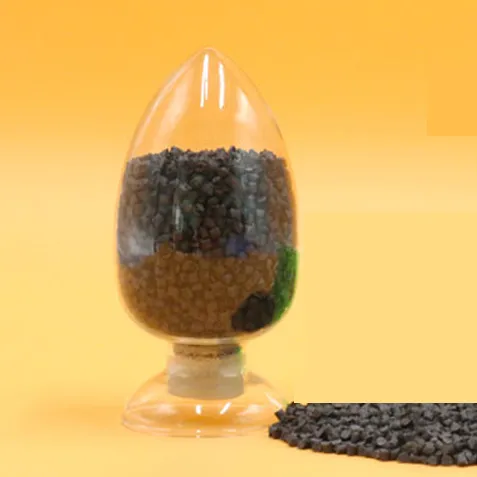
Features of 770CA30 Carbon-Fiber-Reinforced PEEK
The composite inherits PEEK’s inherent advantages—such as chemical resistance, flame retardancy, and low moisture absorption—while significantly improving mechanical strength, stiffness, and wear resistance. Below are its core properties (tested per international standards):
Mechanical Performance: Tensile strength ranges from 260 MPa (yield) to higher values (break, depending on testing conditions). Elongation at break is around 45%, balancing ductility and rigidity. Flexural strength reaches approximately 165 MPa (yield), and flexural modulus is 4.1 GPa, indicating excellent load-bearing capacity. Charpy notched impact strength is 7 kJ/m², while Izod notched impact strength is 7.5 kJ/m², demonstrating moderate toughness.
Thermal Stability: The material exhibits outstanding thermal resistance: melting point is 343℃, glass transition temperature (Tg) is 143℃, and heat deflection temperature (HDT) at 1.8 MPa is 152℃. Its low coefficient of thermal expansion (45 ppm/K below Tg, 120 ppm/K above Tg) ensures dimensional stability under temperature fluctuations.
Physical & Electrical Characteristics: Density is 1.4 g/cm³ (higher than pure PEEK due to carbon fiber filler). Melt flow index (MFI) is 2.3 g/10 min (380℃, 5kg), indicating moderate processability for injection molding. Dielectric strength is 23 kV/mm (2mm thickness), and volume resistivity is 10¹⁶ Ω·cm (23℃), making it a reliable electrical insulator even in harsh environments.
Other Notable Features: The composite has a Shore D hardness of 85, offering scratch resistance. Water absorption is minimal (0.04% by immersion for 24h at 23℃), ensuring dimensional stability in humid or wet conditions. It also retains PEEK’s inherent flame retardancy (UL 94 V0 rated without additional additives) and low smoke emission, critical for safety-critical applications.
Specifications of 770CA30 Carbon-Fiber-Reinforced PEEK
 PEEK®—770CA30 PEEK®—770CA30 |
| Test Item | Test Standard | Test Conditions | Unit | Test Data |
| Mechanical Properties |
| Tensile Strength | ISO 527 | Fracture, 23°C | MPa | 260 |
| Elongation at Break | ISO 527 | Fracture, 23°C | % | 1.7 |
| Flexural Strength | ISO 178 | Fracture, 23°C | MPa | 380 |
| Flexural Modulus | ISO 178 | 23°C | GPa | 23 |
| Compressive Strength | ISO 604 | 23°C | MPa | 300 |
| Impact Strength of Simply Supported Beam | ISO 179/1eA | Notched | kJ m-2 | 7 |
| ISO 179/1U | Unnotched | kJ m-2 | 45 |
| Impact Strength of Cantilever Beam | ISO 180/A | Notched | kJ m-2 | 9 |
| ISO 180/U | Unnotched | kJ m-2 | 45 |
| Forming Shrinkage Rate | ISO 294-4 | Parallel to flow direction | % | 0.1 |
| Perpendicular to flow direction | % | 0.5 |
| Thermal Performance |
| Melting point | ISO 11357 | - | ℃ | 343 |
| Glass transition temperature | ISO 11357 | Initial | ℃ | 143 |
| Specific heat capacity | DSC | 23°C | kJ kg-1 ℃-1 | 1.8 |
| Thermal expansion coefficient | ISO 11359 | Below Tg along flow direction | ppm K-1 | 5 |
| Above Tg along flow direction | ppm K-1 | 6 |
| Heat deflection temperature | ISO 75-f | 1.8 Mpa | ℃ | 336 |
| Thermal conductivity | ISO 22007-4 | 23℃ | W m-1 K-1 | 0.95 |
| Liquidity |
| Melt Index | ISO 1133 | 380℃, 5kg | g 10min-1 | 2.3 |
| Others |
| Density | ISO 1183 | Crystallization | g cm-3 | 1.4 |
| Non-crystallization | g cm-3 | - |
| Shore D Hardness | ISO 868 | 23°C |
| 88 |
Water Absorption Rate (3.2mm Thick Tensile Rod)
(Immersion Test) | ISO 62-1 | 24h, 23°C | % | 0.04 |
| Equilibrium, 23°C | % | 0.3 |
| Electrical Properties |
| Dielectric Strength | IEC 60243-1 | 2mm | kV mm-1 | - |
| Compared to Tracking Index | IEC 60112 | - | V | - |
| Dielectric Constant | IEC 60250 | 23℃, 1kHz | - | - |
| 23℃, 50Hz | - | - |
| Tangent of Loss | IEC 60250 | 23℃, 1MHz | - | - |
| Volume Resistivity | IEC 60093 | 23℃, 1V | Ω cm | 105 |
| 275℃ | Ω cm | - |
Applications of 770CA30 Carbon-Fiber-Reinforced PEEK
770CA30 is widely adopted in industries where lightweight, high-strength, and durable materials are essential:
Automotive: Used in fuel pumps, gearboxes, ABS functional components, and electronic pump parts. It helps reduce vehicle weight (thereby lowering fuel consumption and emissions), decreases noise, and extends the service life of wear-prone parts. For example, Robert Bosch GmbH uses 30% carbon fiber-reinforced PEEK to replace metal in ABS systems, improving reaction time by reducing rotational inertia.
Aerospace: Ideal for aircraft balance devices, engine components, and structural parts (e.g., Boeing 757-200 series fairings). Its high strength-to-weight ratio, thermal stability, and resistance to fatigue make it a preferred choice for aerospace manufacturers seeking to reduce component weight while maintaining performance.
Medical: Suitable for orthopedic implants (e.g., hip sockets, spinal fusion devices) and surgical instruments. Its biocompatibility, wear resistance (superior to ultra-high molecular weight polyethylene), and proximity to human bone elasticity reduce implant rejection risks and improve long-term performance.
Electronics & Electrical: Used in vacuum suction cups, IC wafer carriers, and test sockets. The material maintains electrical insulation properties under high temperature, humidity, and pressure, ensuring reliability in semiconductor manufacturing and handling processes.
Industrial: Applied in valve seats, connectors, and sealing rings for high-temperature and corrosive environments (e.g., chemical processing, oil and gas). Its resistance to chemicals (except concentrated sulfuric acid) and thermal degradation makes it a durable choice for industrial equipment.
 English